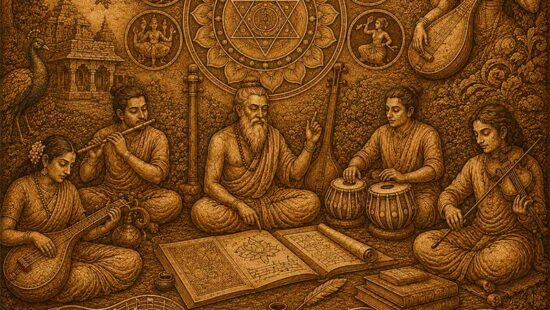
Indian System of Creative Thinking and Music
₹2,500.00(GST additional)
About The Course
This course is an immersion into the Śāstra-Prayoga (Theory-Practice) continuum of the Indian knowledge tradition, exploring the heartbeat of creativity through music and aesthetics. It moves beyond mere historical study to examine the Vedic and Upanishadic foundations of beauty and bliss, providing a lens to view the world through the core principles of Ānanda (bliss) and Rasa (aesthetic essence). By grounding the student in the epistemic foundations of the Nāṭyaśāstra and the Saṅgīta Ratnākara, the curriculum bridges 13th-century wisdom with modern design thinking and innovation.
Syllabus
- Unit 1: Music and its Paradigm in Indian Knowledge Tradition
- ● Importance of music as a rigorous knowledge system and art form in the Indian world.
- ● The Vedic origins of melody and the spiritual significance of sound-science.
- ● Historical Evolution: Tracing the development of Indian music through different historical periods.
- ● Introduction to the foundational thought processes that define the Indian musical tradition.
- Unit 2: Musical Knowledge in Practice and Application
- ● Detailed study of the Saṅgīta Ratnākara (13th CE) as a technical reference point for musical principles.
- ● Examining significant music texts and the evolution of musical ideas and terminology over centuries.
- ● Understanding the essentiality of practice (prayoga) as a necessary precedent to analytical musical thinking.
- ● Analyzing the technical and Śāstric aspects of the knowledge system through its application.
- Unit 3: Contemporary Evolution and Sound Cognition
- ● Seeing how contemporary practice retains threads of continuity with knowledge discussed in 1300 CE.
- ● Recognizing the changes that help modern musical practice retain its vibrancy.
- ● Practical listening activities focused on the recognition of tonal patterns and melodic forms.
- ● Engaging with the aesthetics of Carnatic music through active sound analysis.
- Unit 4: Foundations and Philosophical Insights of Aesthetics
- ● Introduction to Eastern and Western perspectives on aesthetics and the Vedic principles of beauty.
- ● Exploring Upanishadic ideas of Ānanda (bliss) and the philosophical foundations of aesthetic theories.
- ● Comparative analysis of how beauty is perceived across cultures and historical periods.
- ● Examining the relationship between ancient texts and the perception of natural beauty.
- Unit 5: Aesthetic Creativity and Design Thinking
- ● Introduction to the Nāṭyaśāstra and its relevance to modern dramatic narratives and imitation in art.
- ● Balancing Loka-Dharmi (realism) and Nāṭya-Dharmi (idealism) in design and artistic vision.
- ● Integrating human-centered design principles, prototyping, and user testing with aesthetic creation.
- ● Exploring the role of Pratibhā (imagination) and Aucitya (propriety/congruence) in various art forms.
More Information
- Learning Objectives
- ● Critically examine and compare the notions of subjectivity and objectivity across global aesthetic theories, grounded in the Indic perspective.
- ● Internalize the foundational principles of aesthetics and music as outlined in the Vedic and Upanishadic traditions.
- ● Demonstrate how practice is an essential precedent to analytical thinking, using listening activities to cultivate the cognition of sound and form.
- Intended Outcomes
- ● Develop a critical understanding of how ancient aesthetic and śāstric ideas remain relevant in modern contexts, especially through the evolution of Carnatic music.
- ● Understand music as a knowledge system, recognizing the importance of practice in shaping musical thinking and analysis.
- ● Connect traditional aesthetic concepts with contemporary expressions, while tracing continuity between historical and modern musical practices.
- ● Build listening and analytical skills to recognize tonal patterns and appreciate the aesthetic depth of Carnatic music.