About The Course
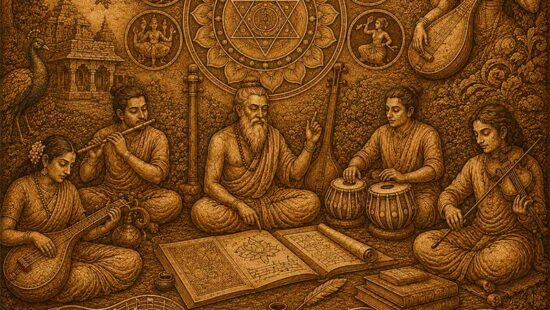
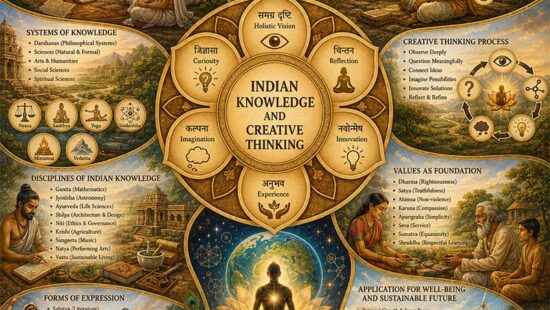
The program synthesises ancient philosophical insights with the Indian Knowledge System (IKS) framework and its profound influence on creativity, art, and innovation. It connects the foundational structure of traditional knowledge—including the Vedas and the 64 arts (Catuṣṣaṣṭhi Kalās)—with the philosophical and Vedic underpinnings of beauty and aesthetics. By integrating classical theories from the Nāṭyaśāstra with modern Design Thinking and human-centered design principles, the course enables learners to apply ancient concepts of imagination (Pratibhā) and propriety (Aucitya) to solve contemporary creative and technical challenges.
Syllabus
- Unit 1: Knowledge and its Paradigm in Indian Knowledge Tradition
- ● Importance and stature of knowledge in the Indian world
- ● Foundations of knowledge: the Vedas
- ● Caturdaśa-Vidyāsthānas (excluding 4 Vedas)
- ● Catuṣṣaṣṭhi Kalās
- ● Structure and content of the four Vedas
- ● Vedangas: Śikṣā, Nirukta, Vyākaraṇa, Jyotiṣa, Chandas, Kalpa
- Unit 2: Indian Knowledge in Practice and Application
- ● Upavedas and applications: Āyurveda, Gāndharvaveda, Dhātuvāda
- ● Applied sciences: Temple architecture, Town planning
- ● Specialized knowledge systems: Gandha-śāstra, Ālekhya-vidyā, Ratna-parīkṣa, Yantra-mātr̥kā
- Unit 3: Foundations and Philosophical Insights of Aesthetics
- ● Introduction to Aesthetics: Eastern and Western Perspectives
- ● Understanding Vedic Principles of Beauty
- ● Western Aesthetics: Classical to Contemporary
- ● Philosophical Foundations of Aesthetics
- ● Comparative Analysis of Subjectivity and Objectivity in Aesthetic Concepts
- ● Vedas and the Aesthetics of Nature and Art
- ● Upanishadic Ideas of Beauty and Ānanda
- ● The Harmonic Confluence of Philosophy, Aesthetics, and the Artistic Drama
- Unit 4: Classical and Modern Aesthetic Theories
- ● Nāṭyaśāstra and Its Relevance in Modern Aesthetics
- ● Classical Aesthetics and Its Influence on Art
- ● Introduction to Nāṭyaśāstra
- ● Imitation and Expression in Art and Dramatic Narratives
- ● Realism and Idealism – Loka-Dharmi and Nāṭya-Dharmi
- ● Balancing Vision and Reality in Creativity and Design
- ● Itivṛtta (Plot) Analysis- Part 1
- ● Itivṛtta (Plot) Analysis- Part 2
- ● Extending Plot Analysis to Narrative Literature
- Unit 5: Aesthetic Creativity and Design Thinking
- ● Interpreting Aesthetic Philosophies from Various Traditions
- ● Cross-Cultural Interpretations and Perspectives
- ● Functions of Design
- ● Human-Centered Design Principles
- ● Prototyping and User Testing
- ● Integrating Design Thinking with Aesthetic Creation
- ● Shapes, Patterns and Meanings
- ● The Role of Pratibhā in Aesthetics
- ● Concepts of Imagination in Art
- ● Understanding Aucitya in Aesthetics
- ● The Role of Propriety, Unity, and Congruence
- ● Exploring Aucitya in Various Art Forms
More Information
- Learning Objectives
- The course aims to:
- ● Cultivate a foundational understanding of the Indian knowledge framework, its components, and its specific contributions to technical and artistic fields.
- ● Valorise the Vedic and Upanishadic conceptions of beauty and the philosophical foundations that underpin Eastern aesthetic theories.
- ● Fortify learners with the analytical frameworks that balance vision and reality by applying concepts such as Loka-Dharmi (realism) and Nāṭya-Dharmi (idealism) to modern narratives and design.
- ● Encourage the application of human-centered design principles and cross-cultural interpretations to promote innovative and sustainable problem-solving.
- Intended Outcomes
- Upon completion of the course, students will be able to:
- ● Explain and articulate the key principles of Indian philosophy, its structure, and the similarities or differences between Eastern and Western aesthetic principles.
- ● Apply traditional concepts like Pratibhā and Aucitya to modern creative contexts, enhancing the ability to innovate in design and literature.
- ● Integrate Design Thinking with aesthetic theory to develop prototypes and creative solutions that are grounded in cultural wisdom.
- ● Demonstrate how ancient Indian insights into nature, art, and mechanics can be used to address 21st-century academic and professional challenges.