About The Course
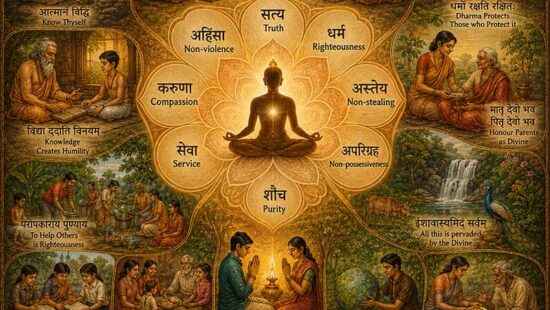
This course explores the core human values embedded in Indian philosophical traditions and their relevance to modern education and society. It connects the ideals of holistic living, ethical responsibility, and Vasudhaiva Kuṭumbakam (the interconnectedness of human life with the cosmos) with the principles of the Indian education system. By integrating philosophy with pedagogy, the course enables learners—especially future educators—to apply value-based approaches in teaching, learning, and building an inclusive and sustainable society.
Syllabus
- Unit 1: The Bhāratīya Worldview and Human Aspiration
- ● This unit explores the fundamental philosophical outlook of the Indian tradition regarding the cosmos and the ultimate aims of human life.
- ● Understanding the relationship between Prakṛti (matter) and Puruṣa (consciousness) and the significance of the Pañca-mahābhūtas (five great elements).
- ● Exploring the root of sorrow and the quest for salvation and eternal peace.
- ● Deep diving into the aims of human life: Dharma, Artha, Kāma, and Mokṣa.
- ● Understanding the concepts of Abhyudaya (material welfare) and Niśreyasa (spiritual liberation).
- ● Introduction to the Dharma Sūtras and Śāstras that guided societal aspirations.
- Unit 2: Foundations of Self and Social Harmony
- ● This unit focuses on discovering the nature of the self and the frameworks established for individual purpose and societal balance.
- ● Exploring the Atman-Brahman relationship as detailed in the Taittarīya upaniṣad.
- ● Studying the Pañca kośas (five sheaths) and the four states of consciousness.
- ● Introduction to Varṇa, Āśrama, Svadharma, and Sāmānya Dharma.
- ● Understanding the importance of Brahmacarya, Gṛhastha, Vānaprastha, and Sannyasa.
- ● Exploring Nītiśāstra and the classification of Karma to foster social harmony.
- Unit 3: Philosophy and Ethical Underpinnings of IKS
- ● This unit introduces the philosophical foundations of the Indian Knowledge Systems and their application to modern ethics and morality.
- ● Understanding the core philosophy and conceptual underpinnings of Indian traditions.
- ● Distinguishing between myths and facts regarding the Indian knowledge tradition.
- ● Exploring Nitiśāstra and its relevance to character building in modern education.
- ● Overview of the Darśanas, including Nyāya and its logical systems.
- ● Identifying philosophical foundations that remain relevant for contemporary educational needs.
- Unit 4: Pedagogical Tools and Communication Models
- ● This unit explores the traditional teaching-learning strategies of Bharat and how they can be integrated into contemporary classroom settings.
- ● Insights into curriculum development and strategies for incorporating IKS into teaching.
- ● Exploring IKS models of communication through linguistics, stories, and metaphors.
- ● Applying Pañcatantra pedagogy as a tool for teaching values and complex concepts.
- ● Practical methods for combining IKS insights with modern academic disciplines.
- ● Documenting and understanding the diverse learning systems that have permeated the tradition across generations.
- Unit 5: Knowledge Protection, Sustainability, and Relevance
- ● This unit focuses on the mechanisms for protecting traditional knowledge and its real-world application for a sustainable future.
- ● Understanding legal frameworks, IPR, and the Traditional Knowledge Digital Library (TKDL).
- ● Exploring Pramāṇa Śāstra for knowledge acquisition and validation.
- ● Case studies of IKS principles in Vāstu, Āyurveda, agriculture, and traditional crafts.
- ● Exploring the facets of Yoga beyond āsanas, focusing on psychology and mental well-being.
- ● Analysing the relevance of IKS for Sustainable Development Goals (SDGs) in governance and management.
More Information
- Learning Objectives
- ● Cultivate universal human values and ethical awareness based on Indian knowledge traditions.
- ● Promote holistic understanding of human life, its connection with society, nature, and the cosmos.
- ● Equip learners, especially future educators, with value-based perspectives and responsible teaching practices.
- ● Encourage the application of Indian Knowledge Systems for inclusive, sustainable, and harmonious living.
- Intended Outcomes
- ● Understand and explain key principles of Indian philosophy and human values.
- ● Apply value-based and ethical thinking in personal, social, and educational contexts.
- ● Integrate Indian Knowledge Systems with modern teaching and learning practices.
- ● Demonstrate responsibility towards building an inclusive, sustainable, and value-driven society.