About The Course
This course takes you on a journey into the governance and management practices of ancient Tamilagam, where leadership was not just about power, but deeply rooted in Dharma—a sense of ethical responsibility towards society. From the Sangam age to the medieval period, learners will explore how well-structured administrative systems, local governance, and efficient resource management helped build stable and prosperous communities. Drawing from rich sources like ancient Tamil literature and inscriptions on stone and copper plates, the course brings to life how decisions were made, leaders were chosen, and systems were sustained with fairness and accountability. More importantly, it connects these time-tested ideas to today’s world, helping learners see how ethical governance and value-based management can address modern challenges in leadership, policy, and society.
Syllabus
- Unit 1: The Bhāratīya Worldview and Human Aspiration
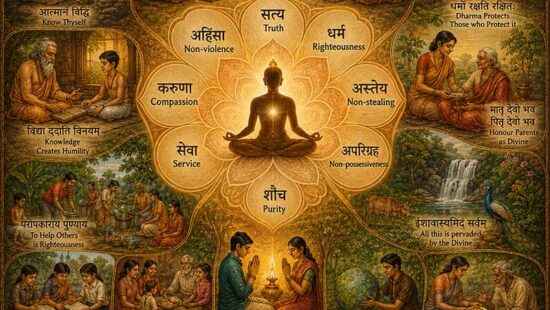
- ● This unit explores the fundamental philosophical outlook of the Indian tradition regarding the cosmos and the ultimate aims of human life.
- ● Understanding the relationship between Prakṛti (matter) and Puruṣa (consciousness) and the significance of the Pañca-mahābhūtas (five great elements).
- ● Exploring the root of sorrow and the quest for salvation and eternal peace.
- ● Deep diving into the aims of human life: Dharma, Artha, Kāma, and Mokṣa.
- ● Understanding the concepts of Abhyudaya (material welfare) and Niśreyasa (spiritual liberation).
- ● Introduction to the Dharma Sūtras and Śāstras that guided societal aspirations.
- Unit 2: Foundations of Self and Social Harmony
- ● This unit focuses on discovering the nature of the self and the frameworks established for individual purpose and societal balance.
- ● Exploring the Atman-Brahman relationship as detailed in the Taittarīya upaniṣad.
- ● Studying the Pañca kośas (five sheaths) and the four states of consciousness.
- ● Introduction to Varṇa, Āśrama, Svadharma, and Sāmānya Dharma.
- ● Understanding the importance of Brahmacarya, Gṛhastha, Vānaprastha, and Sannyasa.
- ● Exploring Nītiśāstra and the classification of Karma to foster social harmony..
- Unit 3: Governance and Dharma in the Tamil Tradition
- ● This unit transitions to the practical application of governance in ancient Tamil Nadu, focusing on the administrative structures guided by Dharmic principles.
- ● Insights from Tamil Sangam texts, the Eighteen Moral Texts, and the Silappadhigāram.
- ● Exploring the concept of Rāj Dharma and the specific responsibilities of the King.
- ● The roles and responsibilities of Ministers, Commanders, and other key officials.
- ● The functioning of village councils, the election process, and the structure of various departments (Vāriyams).
- ● Using Tamil inscriptions (stone and copper plates) as primary sources for understanding historical governance models.
- Unit 4: Financial Ethics and Leadership Management
- ● This unit focuses on the management of resources and the ethical leadership principles used to sustain the state and its people.
- ● Management of land ownership, types of land, and the foundational principles of revenue and expenses.
- ● Understanding various types of taxes (Land, Professional, Social) and the modes of collection.
- ● Basic tenets of management are rooted in ethics and the role of Dharma in leadership.
- ● Principles of effective leadership and decision-making in a historical context.
- ● Managing personnel and resources within the framework of ancient societal values.
- Unit 5: The Legal System and Judicial Practices
- ● This unit explores the structure of the legal system and the execution of justice in ancient Tamil society.
- ● Introduction to the legal system and the application of Smṛtis in the local context.
- ● Exploring the hierarchy of courts, including village courts and the role of the King’s court.
- ● The qualifications required for legal officials and their ethical duties.
- ● Understanding the procedures for handling both civil and criminal cases.
- ● Mechanisms used for resolving disputes and maintaining social order through justice.
More Information
- Learning Objectives
- ● Explore the heart of Indian philosophy to see how it shaped one of the world's oldest and most successful civilisations.
- ● Learn to lead with values by studying how ancient Tamil governance prioritized ethical management over simple power.
- ● Connect the dots between ancient wisdom and your own path toward overall well-being and societal harmony.
- Intended Outcomes
- ● Gain a fresh perspective on how a society can thrive when it is built on a foundation of inclusive Bhāratīya values.
- ● Level up your thinking by understanding how ancient ethics can make you a more well-rounded and effective person in the modern world.
- ● Develop an informed and responsible perspective on building ethical and inclusive societies.