About The Course
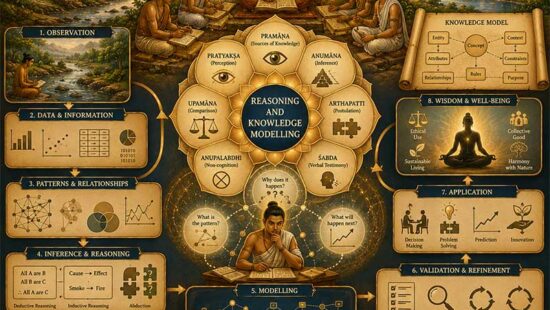
This course delves into the mechanisms of converting raw information into structured knowledge by bridging the Indian tradition of scientific modelling with the rigorous analytical tools of Buddhist logic. It investigates the "Navya Nyāya" approach to model-based reasoning—a method designed to explain and control the observed environment—and fuses it with the disciplined inquiry found in traditional debate. Learners will scrutinise how worldview-driven models and logical syllogisms can be recontextualised to enhance critical thinking and solve complex, real-world problems in the modern professional landscape.
Syllabus
- Unit 1: The Process of Knowledge Creation
- ● This unit establishes the fundamental definitions and frameworks required to understand how knowledge is extracted and systematised within an Indian scientific context.
- ● Knowledge vs. Knowledge Systems: Distinguishing between information (knowledge) and the process used to extract it (knowledge system).
- ● The Framework of Knowledge: Exploring the participants, states, and framework that define how knowledge is acquired.
- ● Understanding science as a method and the tools used to perform scientific inquiry.
- ● Identifying the core objectives of science: to explain, predict, and control phenomena.
- ● Introduction to proof by contradiction and supersensory perceptions within the knowledge framework.
- Unit 2: Fundamentals of Knowledge Modelling
- ● This unit introduces Model-Based Reasoning as the core method for scientific inquiry and explores the various types of models used to represent reality.
- ● Understanding models as compact representations of observed reality.
- ● The use of abstraction and classification to build theoretical or empirical frameworks.
- ● Comparing Top-Down, Bottom-Up, and Hybrid models, as well as the distinction between Exact and Approximate models.
- ● Analysing the boundaries between scientific inquiry and artistic expression in the context of model building.
- ● Recognising the influence of worldviews and the subjective element in scientific modelling.
- Unit 3: Anatomy and Application of Scientific Models
- ● This unit focuses on the internal structure of models and their practical application within the Indian Knowledge Systems.
- ● Identifying the entities, states, and relations that form the anatomy of a model.
- ● Understanding the actions that trigger transitions in the state of entities within a system.
- ● Criteria for assessing the robustness and quality of scientific models.
- ● Applying Navya Nyāya and other Bhāratīya syllogism frameworks to represent complex questions.
- ● Illustrations of model building from Āyurveda and contemporary IKS applications.
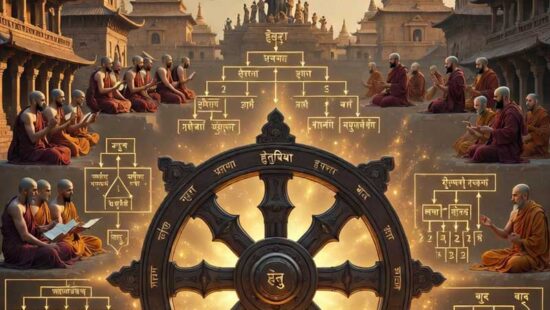
- Unit 4: Introduction to Buddhist Reasoning and Debate
- ● This unit focuses on the logical foundations and the role of structured argumentation.
- ● Exploring the historical and philosophical significance of Buddhist reasoning.
- ● Understanding why debate is central to intellectual traditions and its use as a tool for self-inquiry.
- ● Introduction to key concepts such as comparison, inference, and the basics of logical analysis.
- ● Examining the link between logical inquiry, ethics, and the path to enlightenment.
- ● Refining modern reasoning by using Buddhist logical categories in everyday thinking.
- Unit 5: Buddhist Syllogistic Theory and Ontology
- ● The unit covers advanced Buddhist logic, including the unique structures of its syllogisms and its ontological underpinnings.
- ● Catuṣkoṭi: Mastering the Four-Cornered Logic of early Buddhism and the "logic beyond logic".
- ● Differentiating between statements of qualities and statements of pervasion (Vyāpti).
- ● Understanding the mechanics of Forward Pervasion and Counterpervasion in forming valid arguments.
- ● Exploring the building blocks of reality, including matter, consciousness, and the concept of selflessness.
- ● Understanding the "glue of existence" through non-associated compositional factors.
- ● Utilizing the power of "what-if" scenarios and thoughtful questioning in rational discourse.
More Information
- Learning Objectives
- The course aims to:
- ● Nurture a fundamental grasp of the knowledge-creation process and the specific methods of scientific inquiry unique to the Indian tradition.
- ● Empower participants with structured argumentation techniques and syllogistic frameworks to deconstruct complex philosophical and ethical issues.
- ● Illuminate the influence of worldviews and theoretical principles on the construction of scientific and medical models, illustrated through systems like Āyurveda.
- ● Foster intellectual discipline by training students to differentiate between valid and invalid reasoning through the lens of traditional Indian epistemology.
- Intended Outcomes
- Upon completion of the course, students will be able to:
- ● Articulate and implement the core principles of the Navya Nyāya modelling system and Buddhist logical structures in diverse academic settings.
- ● Evaluate and fortify the robustness of scientific models by applying the rigorous quality criteria established in the Vedic scientific framework.
- ● Conduct high-level reasoned inquiry using the Bhāratīya syllogism framework to navigate modern critical thinking challenges.
- ● Reconstruct ancient śāstras as functional models for contemporary applications, contributing to a value-driven and sustainable global society.